For the better part of two decades, anyone running paid media campaigns in the UK has worked from a fairly set group of providers: Google for intent, Meta for reach, with everything else filling in the gaps. But now, that group has just acquired a new feature. ChatGPT Ads are live here in the UK, and as of the past few days, UK businesses can run them through OpenAI's own self-serve Ads Manager, rather than waiting for a sales call.
We’re not here to rewrite a press release. Instead, let us give you the full practitioner’s guide on what’s available right now, what isn’t and how we think UK advertisers should approach testing the platform before committing to any spending.
What are ChatGPT Ads?
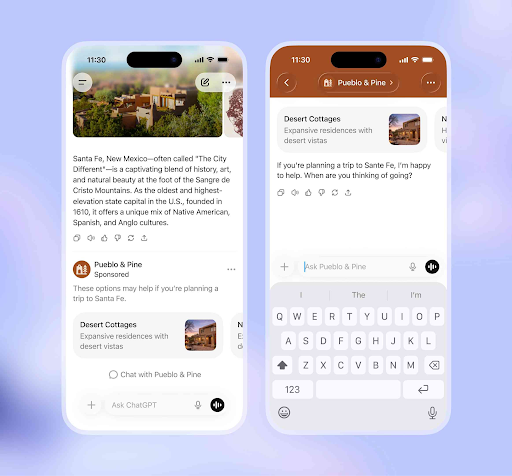
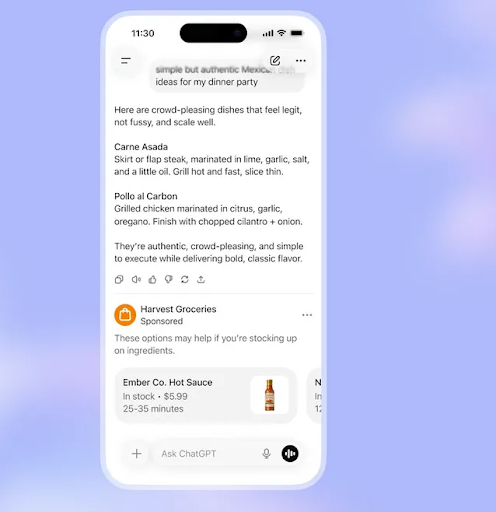
ChatGPT Ads appear as small, clearly labelled "sponsored" cards, sitting beneath ChatGPT's own answer, never inside it. Each card carries:
- a brand name
- a favicon
- a short headline
- a line of supporting copy
- an image
- and a link out to the advertiser's site
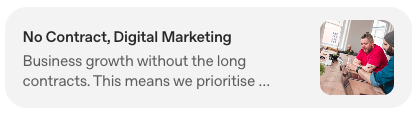
OpenAI has been pretty clear that the format is deliberately minimal: no video, no animated creative and no rich media are displayed. The organic answer generated is never altered to accommodate an advertiser.
Targeting works differently from anything we’ve seen in search, too. Rather than bidding on keywords, advertisers write out in text "context hints", describing the conversations, topics or scenarios where they feel their product is most relevant. OpenAI's models then decide, in real time, whether a given conversation is a good fit. It's closer to briefing a very literal-minded media planner than building a keyword list, which is one of the big things to get your head around if you come from a traditional background and are using Google Ads as a comparison point.
Crucially, ads only show to adult users who are logged in on ChatGPT's Free tier and the lower-cost Go tier. Anyone paying for Plus, Pro, Business, Enterprise or Edu sees no advertising at all, and that’s done by design. It also has a real impact on who you're actually reaching: a large, mainstream, largely non-paying user base, so not necessarily the heaviest power users.
The bigger behavioural difference is the intent behind what a user types. A Google query is a snapshot of a need. A ChatGPT conversation is usually further along and can feature someone comparing options and asking follow-up questions, generally narrowing down a decision before an ad ever appears. That changes what a click is worth, and it should change how you build the page that it takes the user to.
A verified timeline
We get asked a lot of "is this even real yet" questions, so here's the historical timeline, checked against OpenAI's own announcements and the trade press, as of late June 2026:
- 9 February 2026 – OpenAI begins testing ads in ChatGPT in the US, for logged-in adult Free and Go users only. Entry to the pilot initially requires a six-figure minimum spend, reported to be in the region of $200,000–$250,000. Ouch.
- 26 March 2026 – The pilot expands to Canada, Australia and New Zealand. OpenAI reports no measurable impact on consumer trust metrics and low ad dismissal rates from the US test.
- 5 May 2026 – OpenAI opens a self-serve Ads Manager beta to all US businesses. The minimum spend requirement is removed entirely, cost-per-click bidding is introduced (recommended starting bids of $3–$5), and Conversions API / pixel-based measurement arrive. Agency partners (Dentsu, Omnicom, Publicis, WPP) and ad tech partners (Adobe, Criteo, Kargo, Pacvue, StackAdapt) are named.
- 7 May 2026 – OpenAI confirms the pilot will expand "in the coming weeks" to the UK, Japan, South Korea, Brazil and Mexico.
- 2 June 2026 – OpenAI updates its EU advertising policy, requiring explicit opt-in consent before personalising ads for UK and EU users, rather than relying on "legitimate interest".
- 6 June 2026 – ChatGPT Ads go live in the UK, making it OpenAI's first European market. Zalando is named as a launch partner, with Dentsu confirming client campaigns. At this point, UK access is rep-sold only: advertisers register interest and work through an OpenAI representative or agency partner.
- 19 June 2026 – OpenAI begins rolling out a self-serve Ads Manager beta to UK businesses, bringing ChatGPT self-serve ads to this market and narrowing the gap with the US version of the product.
A few things that we couldn't pin down with absolute certainty, and would rather just flag than try to guess, include:
- The exact current minimum-spend recommendation for UK self-serve campaigns
- How completely the self-serve rollout has reached all eligible UK businesses (OpenAI's own language describes this as gradual)
- And whether the UK will get the cost-per-action bidding option that entered early access in the US market in early June.
Why this matters
First Page Sage's Q2 2026 market share estimate puts ChatGPT at around 17% of global digital query volume. This is still dwarfed by Google's roughly 80%, but it’s the first double-digit dent in search behaviour that we’ve seen in two decades.
OpenAI reported 900 million weekly active users in February 2026, which is up from 700 million the previous September. That estimated 17% query share is a third-party figure, not something OpenAI has published itself, and it should be read as directional rather than something too precise. What it tells us, though, is simple: there is a meaningful and growing share of commercial research, and decision-making is now happening somewhere a Google Ads campaign simply can't reach.
We expect that this matters more for some categories than others. Anyone selling something where there is a considered purchase, such as software, financial services, home improvement, travel or B2B services, should expect a growing share of prospects to be "talking it through" with ChatGPT before they turn to a search engine with their query. As OpenAI advertising infrastructure grows and improves, the gap between organic AI visibility and paid AI visibility is only going to get more and more commercially relevant.
What you need before you launch
This is the part you’ll be tempted to skip in the rush to be first. But it's the part that decides whether a ChatGPT Ads test will give you a useful answer or just another number on a dashboard. Here is our advice on learning to walk before you can run:
Tracking has to work before you spend a penny. At the very least, that means a working GA4 implementation with Google Tag Manager underneath it, enhanced conversions where the platform supports them and, most importantly, a way to tie a ChatGPT click through to a CRM record, not just a form-fill event. OpenAI's own measurement tools report platform-side clicks, spend and conversions, but they don't know what a lead is actually worth to you. That's your job.
First-party data is worth preparing now, even though you can't activate it yet. A Customer Match-style audience upload tool was spotted in a gated rollout inside OpenAI's US Ads Manager in mid-May 2026, but it isn't a confirmed, generally available feature, and we haven't seen it inside live UK accounts. You should use this as a prompt to get ready, even if it’s not something that will go live immediately. Clean, deduplicated CRM data with proper consent records may not seem useful this week, but it means you can move immediately when the audience upload does roll out more broadly, instead of losing weeks working on your data hygiene after the fact.
How to test it properly
You should treat the first phase of testing as data collection, not as performance marketing. A few rules we're personally applying to early tests include:
- Create a genuinely separate test budget. Don't fund it by simply trimming Search or PMax. You want a clean judgment, not a channel cannibalisation argument three months from now.
- Set the success metric before launch. Decide upfront whether you're testing for cost-per-lead parity with existing channels, gradual reach or simply learning how the format performs, and don't move those goalposts once you get the results.
- Compare like for like. Check results against your existing channel mix on the same attribution model, even an imperfect one, rather than judging it in isolation.
- Assess the lead quality, not just the volume. A cheap lead your sales team can't close is not a result worth doubling down on.
- Allow for a proper window. A week or two of data from a brand-new auction, in a market this new, tells you almost nothing. We are working towards a minimum 60-day test window as a baseline before drawing conclusions.
The opportunity
Early access genuinely means something here in a way that it hasn't always with new ad platforms. The interface, tools and allowable feeds are still comparatively uncrowded as it stands, while OpenAI is actively recruiting feedback from early advertisers, and the category-eligibility list is still narrow enough that being one of the first relevant brands in a given market carries real weight. Brand visibility inside a conversation someone is having while trying to make up their mind is a different kind of exposure to a search ad. It’s arguably closer to a recommendation than an interruption, if the format holds up once it’s been rolled out further.
But early access is not, by itself, an advantage. It's an option with an advantage. What converts it into one is the same thing that's always converted early access into advantage on any platform: good tracking, honest measurement and the discipline to learn rather than just spend for the sake of it.
The challenges
There are no real benchmarks we’ve seen as of yet. Not for CPC, not for conversion rate and not for what a "good" lead looks like in this environment. Auction dynamics are still settling, the platform is shipping new features roughly weekly, and attribution gets a lot harder when the user's research happens inside a private conversation rather than a tracked browsing session. UK advertisers also now operate under an explicit-consent requirement for ad personalisation that the US market doesn't have, which may affect targeting precision and is worth watching closely as the rollout progresses.
None of this is a reason to wait indefinitely, but it is a reason to test with a plan rather than test on hope.
Our view
We're genuinely excited about this at Adtrak. Conversational AI is a new context in which your audience can discover you, and getting an early, informed look at it is valuable regardless of whether ChatGPT Ads becomes a core channel for any given client or remains a useful top-of-funnel test.
But we're not going to tell clients to shift swathes of their budget out of channels with a decade of data behind it, only to plough it into a platform that's a few weeks into self-serve access in this market. We'll test it properly, with the same tracking discipline we'd insist on for any new channel, and we'll make the call on it based on what the data actually says and what it means for you.
We'd expect this AI advertising platform to look a lot different in twelve to twenty-four months. We hope that it will come with clearer benchmarks, settled auction dynamics, and maybe more ad formats. And the businesses that benefit most from that growth in the platform will be the ones who started building first-party measurement now, while the cost of getting it wrong is still negligible.
Getting started, properly
If you're weighing up whether to test ChatGPT Ads, don’t just ask yourself "should we be in this?", because for most considered-purchase businesses, the answer is probably yes, eventually. The question you need to ask is whether your tracking, your attribution and your definition of a good lead are solid enough to make a small test tell you something useful when the time is right.
If you want a second opinion on whether your measurement setup is ready for a channel like this, or want help running a properly structured test, talk to us.